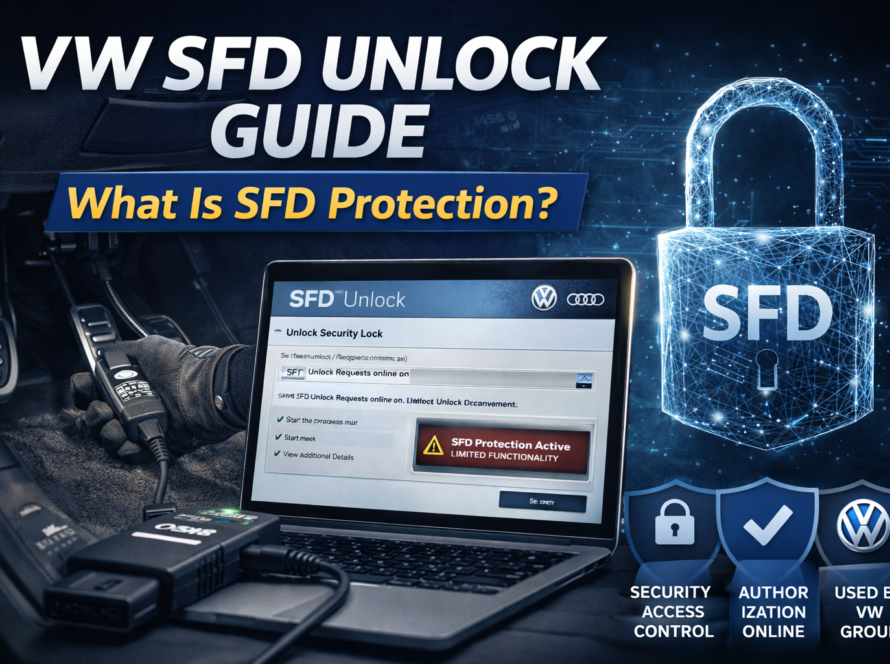
Modern Volkswagen Group vehicles rely heavily on communication with manufacturer servers during diagnostic and configuration procedures.
One of the most important systems involved in this process is FAZIT. It operates in the background, verifying vehicle data and ensuring that all electronic modules are correctly assigned and authorized.
Without FAZIT server communication, many advanced diagnostic procedures cannot be completed.
What Is FAZIT Server Communication
FAZIT server communication refers to the process where diagnostic software, such as ODIS Online, connects to Volkswagen Group backend systems to verify and manage vehicle data.
This communication allows the system to:
- identify the vehicle
- verify installed modules
- authorize diagnostic procedures
- synchronize configuration data
It is a key part of modern vehicle diagnostics.
What Data FAZIT Stores
FAZIT servers contain detailed information about each vehicle.
This includes:
- vehicle identification number (VIN)
- list of installed control units
- module identifiers and serial numbers
- security authentication data
- configuration parameters
Because of this, the system knows exactly how the vehicle should be configured.
How FAZIT Communication Works
When a technician performs an operation using ODIS Online, the process involves real-time communication with FAZIT servers.
- The vehicle is connected to ODIS
- The system reads vehicle data
- Information is sent to FAZIT servers
- The server compares the data with stored configuration
- The system approves or rejects the operation
This happens within seconds but is essential for successful adaptation.
FAZIT and Module Replacement
FAZIT communication is especially important when replacing control units.
When a new or used module is installed:
- the module sends its identification data
- ODIS forwards this data to FAZIT
- the system checks compatibility
- authorization is granted or denied
If approved, the module can be properly adapted to the vehicle.
What Happens If FAZIT Rejects the Module
If the FAZIT server detects a mismatch:
- the system may activate component protection
- module functionality may be limited
- adaptation procedures may fail
- error messages may appear
This is a security feature designed to prevent unauthorized use of components.
FAZIT and Vehicle Security
FAZIT plays a central role in vehicle security systems.
It works together with:
- component protection
- immobilizer systems
- SFD security
Together, these systems ensure that:
- only authorized modules are used
- vehicle configuration remains correct
- unauthorized modifications are blocked
Why FAZIT Communication Is Required
Modern vehicles no longer store all configuration data locally.
Instead:
- critical data is stored on manufacturer servers
- changes must be verified online
- secure authentication is required
Without FAZIT communication, many operations cannot be completed.
Real-World Example
A typical situation:
A used control unit is installed in a vehicle.
- the module powers on
- but functions are restricted
- errors appear
This happens because the module is not yet verified by FAZIT.
After performing an online adaptation:
- FAZIT confirms compatibility
- configuration is updated
- full functionality is restored
Why FAZIT Matters for Technicians
For workshops and technicians, understanding FAZIT communication is essential.
Without it, it is not possible to:
- complete module replacement
- perform secure coding
- remove component protection
- finish advanced diagnostics
Knowing how FAZIT works saves time and avoids unnecessary troubleshooting.
Conclusion
FAZIT server communication is a core part of modern Volkswagen Group diagnostics.
It ensures that all modules are correctly matched to the vehicle and that only authorized operations are performed.
As vehicles become more advanced, this type of server-based verification is becoming standard across the industry.
For anyone working with VW, Audi, Škoda or SEAT vehicles, understanding FAZIT communication is essential.
Need help? We are here for you. whatsapp: +420773585568 mail: info@odisonline.eu
ODISONLINE.EU