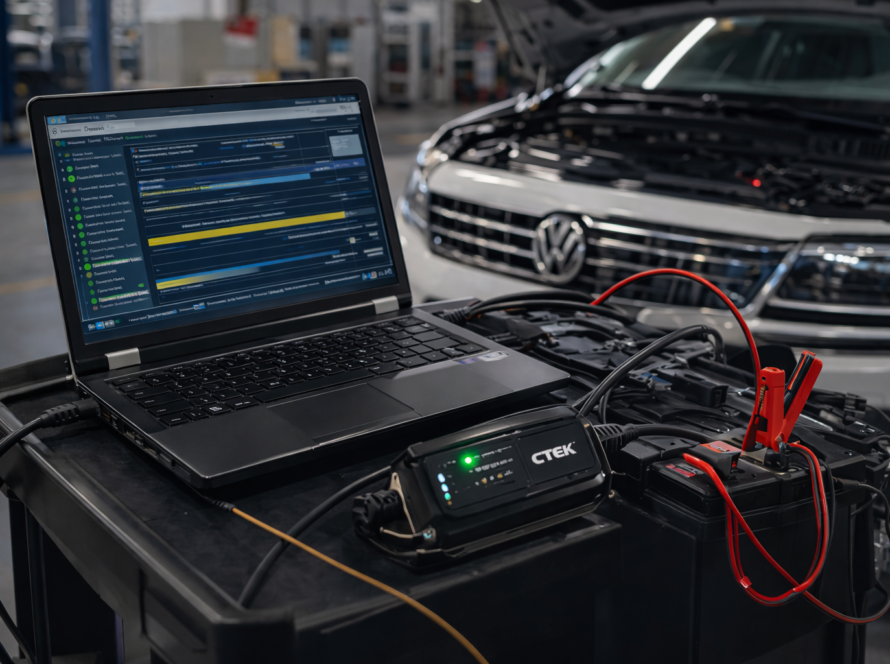
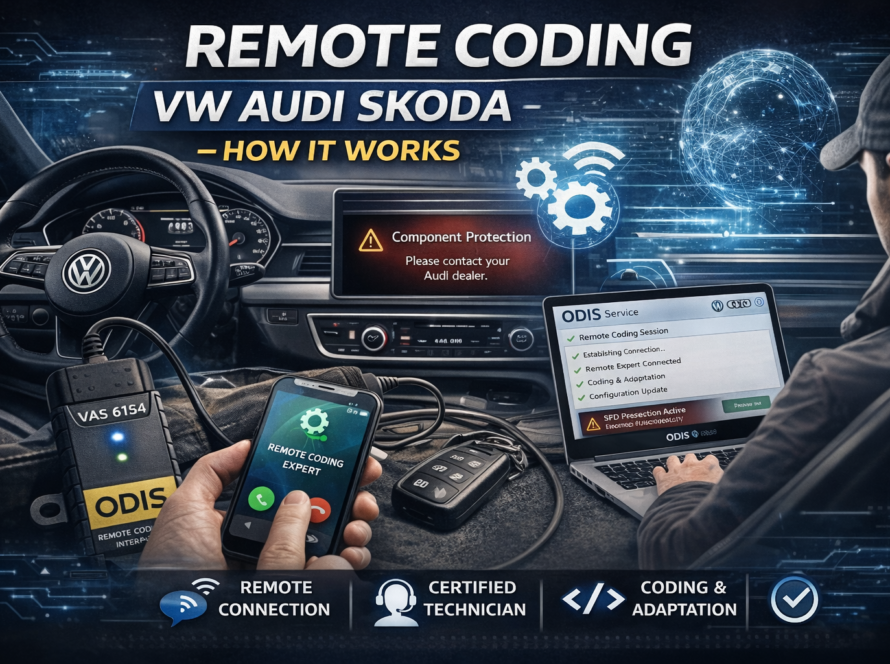
The Engine Control Unit (ECU) is the most critical electronic module in any Volkswagen Group vehicle. Responsible for managing fuel injection timing, ignition control, turbocharger boost pressure, exhaust aftertreatment systems, and a wide range of emission-relevant functions, the ECU operates at the heart of the vehicle’s powertrain. Any disruption to its correct configuration or integration with the vehicle has immediate and significant consequences for performance, emissions compliance, and in some cases, the vehicle’s ability to start and run at all.
ECU adaptation errors represent a category of fault that arises specifically during or after the process of installing and configuring a replacement engine control unit. Understanding the causes, diagnostic approach, and correct resolution procedure for these errors is fundamental knowledge for any technician performing ECU replacement on modern VAG vehicles.
What Is ECU Adaptation and Why Is It Necessary?
ECU adaptation is the process by which a newly installed engine control unit is integrated into the vehicle’s electronic ecosystem. This goes far beyond simply installing the hardware — the ECU must be:
- Coded to match the vehicle’s specific engine variant, transmission type, emissions standard, and market specification
- Adapted to synchronize learned values and calibration data with other control units such as the transmission control module, ABS/ESP unit, and instrument cluster
- Authenticated against Volkswagen’s backend servers to verify that the module is authorized for use in the vehicle
- Immobilizer-matched to the vehicle’s security system, without which the engine will not start
Each of these steps is interdependent. Failure at any stage of the adaptation process can result in ECU adaptation errors ranging from minor calibration mismatches to a complete inability to start the engine.
What Is an ECU Adaptation Error?
An ECU adaptation error is a fault condition that occurs when one or more of the required adaptation steps fail to complete successfully. The error may appear as:
- A specific fault code stored in the ECU or related modules, identifiable through an ODIS diagnostic scan
- An error message displayed in ODIS during a guided adaptation procedure, indicating that a specific step has failed
- The vehicle refusing to start after ECU installation, as the immobilizer adaptation has not been completed
- Reduced engine performance or engine management warning lights, indicating that the ECU is operating in a limited or fallback mode
The error does not necessarily indicate a hardware fault — in the majority of cases, ECU adaptation errors are caused by procedural, software, or authentication issues that can be resolved without replacing hardware.
Common Causes of ECU Adaptation Errors
1. Missing Online Authentication
Modern Volkswagen Group ECUs incorporate component protection that requires online authentication before the unit can be used in a different vehicle. When a replacement ECU — whether new, remanufactured, or used — is installed, it must be authorized through Volkswagen’s backend servers via ODIS Online. If this authentication step is skipped or fails, the ECU will not accept adaptation data and may refuse to allow the engine to start.
This is the single most common cause of ECU adaptation errors in current-generation VAG vehicles and affects an increasingly wide range of models as component protection is extended to cover engine management systems.
2. Incorrect ECU Part Number or Variant
Installing an ECU with an incorrect part number — even one that appears similar to the original — is a frequent source of adaptation errors. ECUs are specific not only to engine type but also to transmission variant, emissions market, model year, and sometimes even regional specifications. An ECU from the wrong variant may accept some adaptation steps but fail others where its internal configuration does not match what the vehicle expects.
3. Immobilizer Adaptation Failure
The ECU must be matched to the vehicle’s immobilizer system as part of the adaptation process. This requires a specific procedure in ODIS that synchronizes the ECU with the immobilizer control unit using the vehicle’s security codes. If this step fails — due to incorrect procedure, missing data, or an incompatible module — the engine will crank but not start, and immobilizer-related fault codes will be stored.
4. Interrupted Programming Procedure
If the ECU programming or adaptation procedure is interrupted mid-process — due to a power failure, loss of internet connection during online authentication, or a diagnostic software crash — the ECU may be left in an indeterminate state. It may contain partially written data that prevents normal operation and causes errors when the procedure is attempted again.
5. ODIS Software Version Incompatibility
Running an outdated version of ODIS may result in incompatibility with the current ECU variant or the server-side authentication protocols. Volkswagen periodically updates both the diagnostic software and the backend systems it communicates with, and version mismatches can cause adaptation procedures to fail in ways that are not immediately obvious from the error messages displayed.
6. Unstable Power Supply During Adaptation
ECU adaptation and programming procedures are sensitive to voltage fluctuations. If the vehicle’s battery voltage drops below acceptable levels during programming, data may be written incorrectly or the procedure may abort prematurely. A battery support unit maintaining stable voltage is a mandatory prerequisite for any ECU programming operation.
7. Bus Communication Issues
The adaptation process requires the ECU to communicate with multiple other control units simultaneously. If there are pre-existing communication faults on the CAN bus or other networks — such as missing modules or wiring faults — the adaptation procedure may be unable to complete the required data exchanges, resulting in errors.
Step-by-Step Diagnostic and Resolution Guide
Step 1 – Verify ECU Part Number Compatibility
Before beginning any diagnostic procedure, confirm that the installed ECU has the correct part number for the specific vehicle. Cross-reference the part number against the vehicle’s original build data using the Volkswagen ETKA parts system or equivalent. If the part number is incorrect, sourcing the correct unit is the necessary first step.
Step 2 – Perform a Full ODIS System Scan
Connect ODIS and perform a complete vehicle scan. Review all fault codes stored in the ECU and related modules, paying particular attention to codes referencing component protection, immobilizer faults, communication errors, and adaptation failures. The fault code pattern provides critical guidance for prioritizing the resolution steps.
Step 3 – Check Battery Voltage and Connect Support Unit
Confirm that the vehicle battery is in good condition and connect a battery support unit set to the appropriate voltage. Stable voltage throughout the adaptation procedure is non-negotiable. Attempting ECU adaptation without a support unit risks procedure interruption and potential ECU damage.
Step 4 – Perform Online Authentication via ODIS Online
Navigate to the ECU adaptation guided function in ODIS and initiate the online authentication procedure. This connects ODIS to Volkswagen backend servers, transmits the ECU and vehicle identification data, and receives the authorization required to proceed with adaptation. Ensure the internet connection is stable before and throughout this step. A failed authentication attempt should not be retried immediately — verify the connection and account status first.
Step 5 – Complete Immobilizer Adaptation
Following successful online authentication, perform the immobilizer adaptation procedure in ODIS. This step synchronizes the new ECU with the vehicle’s immobilizer system and is required before the engine will start. Have the required vehicle security codes available — these are typically obtainable through the Volkswagen dealer system for authorized workshops.
Step 6 – Complete All Required Adaptation Steps
ODIS will guide the technician through all remaining adaptation steps specific to the vehicle and ECU variant. These may include:
- Basic settings procedures for fuel injection and throttle body
- Transmission adaptation if the ECU communicates with a DSG or automatic gearbox
- Lambda probe adaptation for emissions system calibration
- Turbocharger map learning where applicable
Follow all guided steps without interruption, ensuring the engine is at the correct operating temperature where procedures specify it.
Step 7 – Clear Faults and Perform Final Verification
After completing all adaptation steps, clear all stored fault codes from the entire vehicle and perform a final full ODIS system scan. Confirm that no new faults have appeared. Perform a road test to verify normal engine operation across the full operating range and confirm that no warning lights are present.
Online Authentication – The Critical Step Most Often Missed
It is worth emphasizing that online authentication is not optional for replacement ECUs in modern VAG vehicles — it is a mandatory prerequisite that must be completed before any other adaptation step can succeed. Technicians who attempt to skip this step and proceed directly to coding or immobilizer adaptation will invariably encounter errors that cannot be resolved until authentication is properly completed.
The authentication process requires:
- An active, stable internet connection
- A valid, current ODIS technician account with appropriate authorization level
- An approved VAS diagnostic interface
- The vehicle to be stationary with ignition on
If authentication fails repeatedly despite correct credentials and a stable connection, contact Volkswagen technical support. In some cases, the ECU may need to be registered manually in the backend system before ODIS authentication can succeed.
Summary
ECU adaptation errors in Volkswagen vehicles arise from a combination of authentication failures, procedural issues, part number mismatches, and power supply instability. The most critical step in resolving these errors is performing the online authentication procedure through ODIS Online, which authorizes the replacement ECU for use in the vehicle and enables all subsequent adaptation steps. A systematic approach — verifying part compatibility, ensuring stable power, completing authentication, and following all guided ODIS procedures — resolves the vast majority of ECU adaptation errors without the need for further hardware intervention.
Need help? We are here for you. whatsapp: +420773585568 mail: info@odisonline.eu
ODISONLINE.EU